history
There are places best understood when you draw close to the river, and the União das Freguesias de Melres e Medas, in the concelho of Gondomar, is exactly one of them. Here, the Douro is not merely a line of water passing along the horizon — it is a presence, a companion, the thread that stitches together the landscape and the lives of its people. One need only consider how close these lands lie to the great river to understand that much of what is lived, eaten and celebrated here bears the signature of the waters that flow gently down the slopes.
Melres e Medas each preserve, in their own way, a past that can be read in the stones and the pathways. These are two places of strong historical character, shaped by a riverside condition that, across generations, moulded the working lives and ways of their people. Those who live here carry in their memory the rhythm of the river and its banks, the ancient knowledge of those who learned to live alongside the Douro and draw from it both sustenance and celebration. It is a community that recognises itself in its place, proud of its roots and generous towards those who arrive from elsewhere.
When it comes to heritage, these lands offer places well worth seeking out without haste. The Igreja de Nossa Senhora da Assunção (Church of Nossa Senhora da Assunção) is one such landmark — a space of devotion and gathering where the community has long come together, and which speaks eloquently of the importance that faith has always held in the organisation of local life. Nearby, the Capela dos Passos (Chapel of the Passos) adds another dimension to this religious landscape — more secluded, more intimate, yet equally charged with meaning for those who pray and remember here. These are monuments that impose themselves not through grandeur, but through soul, through what they represent in the routines and memories of the people of Melres e Medas.
To walk these riverbanks is, in essence, to let oneself be carried by the scenery of the Douro. The relationship with the river gives the freguesia a character of its own, shaped by slopes, water and horizons that invite you to linger. It is the landscape that gives meaning to everything else: the stories that are told, the crafts that are passed down, the flavours that reach the table. And it is also this deep connection to the river that explains, in large part, why these lands have distinguished themselves by their importance across time.
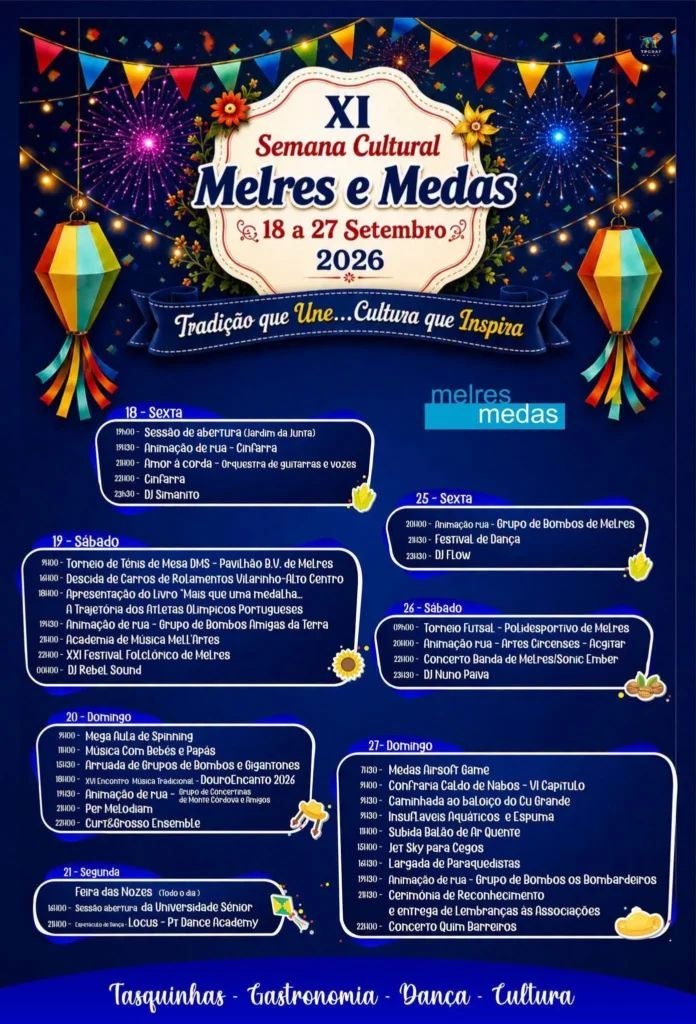
In traditions and customs, the community keeps alive a strong desire to come together and celebrate as one. There is here a genuine love of culture and of sharing, with events that fill entire days and bring music, entertainment and conviviality out into the streets, drawing neighbours and visitors alike. These are moments when the people of Melres and Medas show what they do best: welcome, celebrate and turn the street into a stage for encounter. This community spirit, built on closeness and joy, is perhaps the most beautiful legacy of these lands — proof that here, tradition is no museum piece, but a living thing that renews itself with each season of the year.
And then there is the table, which in this territory always speaks the language of the river. Local gastronomy finds its greatest protagonists in the Douro: the sável (shad) and the lampreia (lamprey), treasures of the waters, prepared here with the care and knowledge of those who inherited the recipes of their elders. These are not year-round dishes — they are seasonal delicacies, awaited with the patience of those who know that the best things come in their own good time. The lampreia, above all, is queen of these kitchens, served with a care that has become an art. Around these products, an entire culinary culture takes shape, one that values the region's ingredients and the skilled hand of the cook, turning the meal into a true moment of celebration. To taste sável or lampreia in Melres e Medas is, at its heart, to taste the Douro itself, with all its generosity.
This is the União de Freguesias: riverside in body and soul, faithful to its churches and chapels, attached to its traditions and proud of the flavours that only the river can bestow. A corner of Gondomar that deserves to be discovered slowly, with the unhurried pace of those who truly wish to know the land and its people.