about the place
In the municipality of Sintra, district of Lisboa, this union of parishes spreads across the heart of the serra, among granite, moss and lush vegetation that the mist transforms into scenery. Here stands the Igreja de Santa Maria de Sintra (Church of Igreja de Santa Maria de Sintra), a Gothic-style temple classified as a National Monument, part of the ensemble that earned Sintra its recognition by UNESCO as a World Heritage Site.
history
There are places defined by stone and landscape, and the parish of Santa Maria, in the mountain heart of Sintra, is one of them. Nestled against the serra that has set kings, poets and travellers from across the world to dreaming, this is a land where granite, moss and mist seem to tell ancient stories to all who pass through. To walk here is to feel the weight and gentleness of centuries, in a place that UNESCO would come to recognise as heritage belonging to all of humanity.
The history of Santa Maria is inseparable from that of the people who, across generations, learned to live in harmony with this generous and demanding serra. These were families of hard work and devotion, who built houses of stone and temples, who carved paths through the lush vegetation and who made of this hillside a place inhabited with soul. Every wall, every narrow lane, every hidden corner holds the memory of those who put down roots here and stayed.
Of all the heritage that Santa Maria embraces, few monuments speak as directly to the heart as the Igreja de Santa Maria de Sintra (Church of Santa Maria de Sintra). A Gothic church, it has been classified as a National Monument and forms part of the ensemble that earned Sintra its recognition as a World Heritage Site. It is one of those buildings that inspire both respect and serenity in all who enter: the worked stone, the light filtering through the openings, the silence that settles within. It is worth taking time to look, to let history reveal itself slowly, because it is in this church that the antiquity and spirituality of the whole of this land are felt most purely.
But the charm of Santa Maria does not end at the walls of a monument. It lives in the landscape itself, in the paths that wind through the serra, in the coolness that rises from the vegetation, in the way the mist descends and transforms everything into the setting of a fairy tale. Those who come up here quickly understand why Sintra has always drawn those who seek beauty and mystery. There are places one visits; Santa Maria is among those one feels.
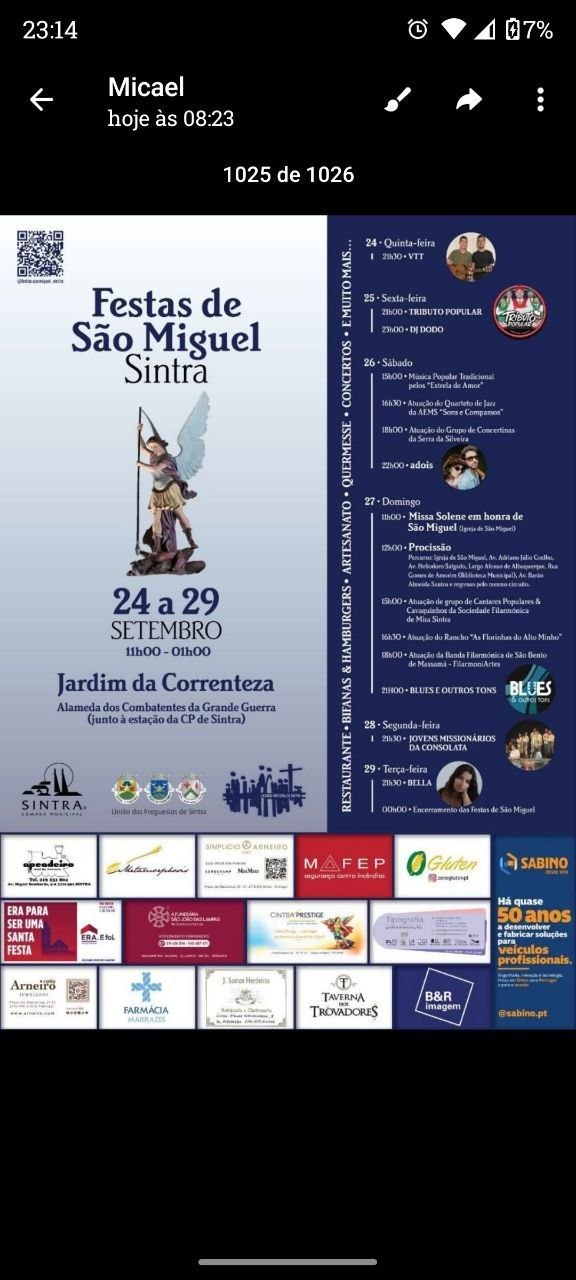
The traditions of this parish are a faithful reflection of the popular soul of Sintra. Throughout the year, communities gather for celebrations that keep local culture alive, with the colour and enthusiasm of neighbourhood festivals, the love of good company and the devotion that passes through generations. These are moments when the land fills with music, people and sharing, and when the elders pass on to the young the knowledge and customs that make them feel they belong to the same place. It is in these expressions that one understands that Santa Maria is, above all, a living community.
And then there is the table, that territory where lands reveal the best of themselves. In Santa Maria, the cuisine is honest and comforting, made from recipes that have crossed time. The sopas do Império (a traditional communal soup served at festive gatherings) warm and bring people together, the caldo de nabos (turnip broth) carries the sincere flavour of the land, and the bolo na panela (a cake cooked in a pot) is one of those sweets that taste of home and memory. To all of this is added the gastronomic tradition of Sintra, which asserts itself in the steaming caldo verde (kale soup) and the leitão assado (roast suckling pig), a dish of celebration and conviviality par excellence. Among the local produce, the biscoitos de orelha (ear-shaped biscuits, a simple confection) hold a special place as part of the identity of Santa Maria, best enjoyed at the unhurried pace of those who know how to savour the finer things.
To visit Santa Maria is, at heart, to let yourself be carried away by a serra that insists on being eternal, by a church that is a jewel of stone, by welcoming people and by flavours that linger in the memory. It is to understand that, in Sintra, beauty is not only what one sees, but also what one tastes, what one celebrates and what one shares. And it is to leave here certain that one will return.