about the place
In the municipality of Sernancelhe, in the district of Viseu, this union of parishes nestles against the mountain ranges of the Beira interior, amid granite, centuries-old chestnut trees and sweeping views over the hills. Sernancelhe is the centre of daily life, with its Igreja Matriz (parish church), while Sarzeda lends its name and soul to the whole. The Solar dos Carvalhos, a listed building of public interest, recalls the days of rural nobility in these lands.
history
There are places kept in the heart of Portugal like a well-kept secret, and this union of parishes, embracing Sernancelhe and Sarzeda, is one of them. Nestled against the mountains of the Beira interior, it is one of those corners where time seems to move more slowly, to the rhythm of the seasons, the work of the fields, and the conversations of people who know each other by name and by face.
Sernancelhe is the heart of this community, the place where the daily life of its people converges, but it would be unfair to tell the story without speaking of Sarzeda, the sister village that lends its name and its soul to this whole. Two settlements, each with its own character, united by the same landscape of granite, ancient chestnut trees, and wide horizons that open out over the hills.
The people of these lands are, above all, people of work and of roots. Generations learned to read the sky and to know the land, who knew how to draw sustenance from the stony soil each day and who made patience and persistence their way of being in the world. It is in that inheritance of calloused hands and knowledge passed from parents to children that the identity of this union of parishes is grounded — a place where collective memory remains alive in stone houses, on ancient paths, and in the stories told by the fireside.
Those who pass through should not move on without pausing to take in the heritage that lends distinction to these lands. In Sernancelhe stands the Igreja Matriz (parish church), a landmark of faith and art that bears witness to the ancient devotion of the people and to the importance this place held through the centuries. In Sarzeda, its church is equally a place of gathering and contemplation, guardian of the religious traditions that have always united this community. But there is one monument that stands out for its history and its grandeur: the Solar dos Carvalhos, listed as a property of public interest, a manor house that speaks of lineages, of times of rural nobility, and of a past when these lands had voice and prestige. Completing this picture, there are chapels scattered across the territory and museums that preserve the memory, small guardians of a past that is not to be forgotten.
Traditions are the thread that stitches the present to the past in this land. Community life is organised around religious devotions, the rituals that mark the calendar, and the moments of conviviality that bring together neighbours and families. It is in those celebrations that one perceives the strength of the bonds uniting the people, the pride in their land, and the desire to keep alive the flames of inherited customs. Here, faith and festivity go hand in hand, and each generation takes it upon itself to pass on to the next the gestures, the prayers, and the joys that make this community a place of belonging.
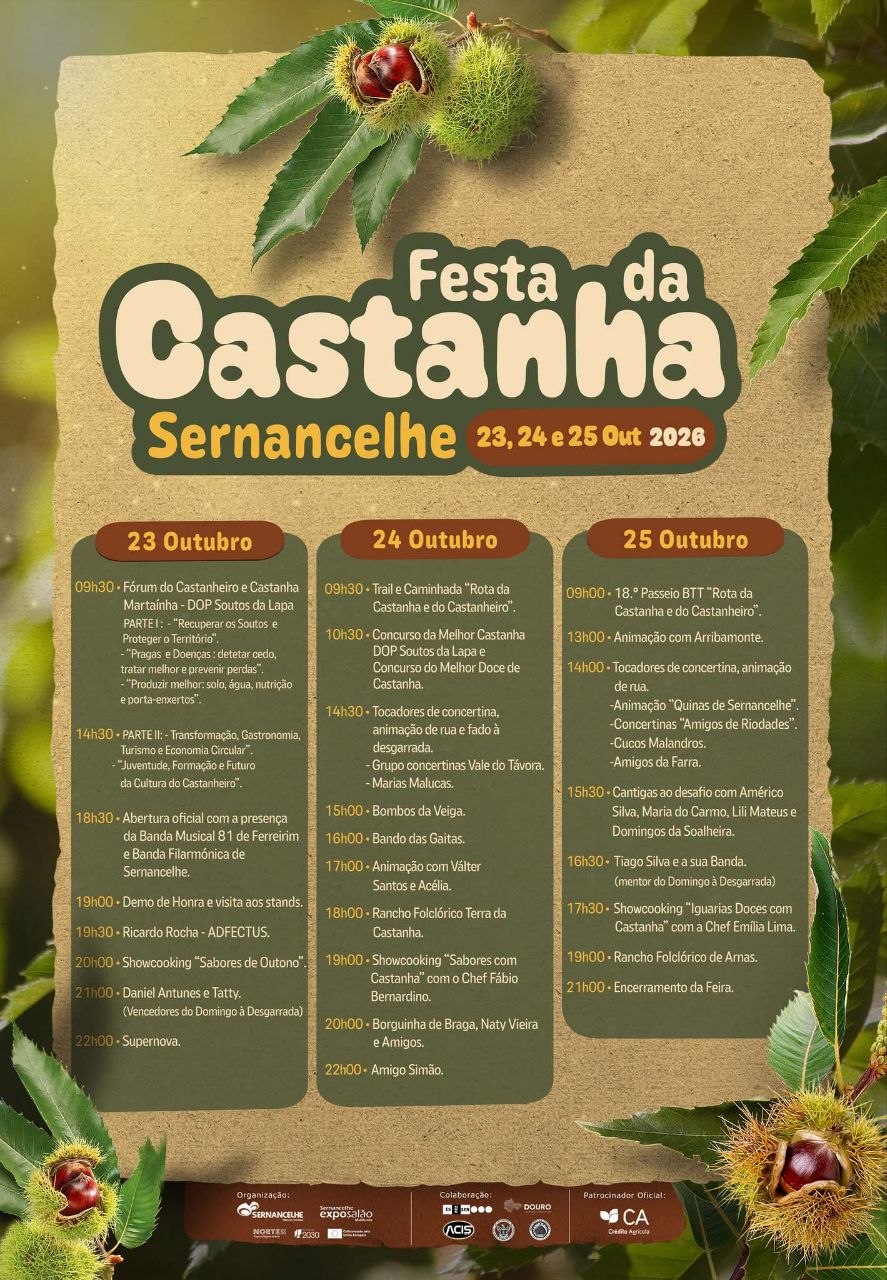
But if there is one thing that fills those who live here with pride, it is what the land offers at the table. Sernancelhe is, par excellence, a land of castanha (chestnut), and the chestnut is queen and mistress of these fields. The chestnut trees that punctuate the landscape are not merely trees: they are living heritage, memory and sustenance, and they yield a fruit that has earned fame and become a true regional emblem. Roasted, boiled, or transformed into delicacies, the castanha from here is a cause for celebration and indulgence. Alongside it, there are quality meats, raised in the pure air of the hills; cheeses that taste of milk and of ancient knowledge; and fresh, fragrant maçãs (apples), picked from the orchards that make the most of this mountain climate. It is an honest cuisine, made from local produce and recipes that have crossed generations, capable of comforting those who arrive and of leaving a longing in those who depart.
To visit Sernancelhe and Sarzeda is, at heart, to accept an invitation: to discover a genuine Portugal, made of stone and chestnut trees, of faith and festivity, of robust flavours and welcoming people. It is a land that does not reveal itself in haste, but that rewards generously those who seek it out with time and curiosity.